-
A Quantum Wish
A baby drops a spoon, and it falls.
Categories: NQCO Letters -
SCQIS Releases Strategic Plan for QIST Workforce
(February 1, 2022) Today the National Science and Technology Council Subcommittee on Quantum Information Science (SCQIS) released its National Strategic Plan for QIST Workforce Development. The report recommends a series of actions and highlights community opportunities to grow the QIST workforce through expanded training and education at all levels. It also highlights the continued importance of gathering data on the workforce needs of industry, academia, and the federal government, and of developing long-term learning opportunities to expand and broaden the nation’s pool of talent and ensure the QIST workforce represents all of America. The report will help guide our Nation’s QIST efforts in the coming years as the Federal government works to strengthen the pool of quantum-ready workers.
-
ARL and LPS release BAA on Quantum Computing in the Solid State
(January, 18 2022) A new Broad Agency Announcement (BAA) for the QC-S5 program, BAA # W911NF-22-S-0006 has been released. The U.S. Army Research Office (ARO), in collaboration with the Laboratory for Physical Sciences (LPS), is soliciting proposals for research in four research topic areas in the field of
gate-based Quantum Computing (QC) in the Solid State with Spin and Superconducting qubit Systems (QC-S5).
The topic areas are as follows:Categories: Quantum Computing, R&D Funding Opportunities -
LPS and NQCO hold workshop on recruiting QIS talent to the federal government.
(Jan 25, 2022) On August 30, 2021, the Laboratory for Physical Sciences (LPS) and the White House Office of Science and Technology Policy (OSTP) held a virtual workshop on the recruitment of individuals with quantum information science (QIS) expertise into government service.
Categories: Workforce -
The FY 2022 NDAA and Quantum
(Dec. 27th, 2021) President Biden signed the National Defense Authorization Act (NDAA) (P.L. 117-81) act for FY 2022. The NDAA is a legislative vehicle for establishing policy and discretionary authorizations for the DOD, nuclear weapons programs of the DOE, and other defense-related activities (see NDAA primer). This year’s NDAA expanded the national quantum information science and technology (QIST) activities via five sections (Sec. 216, Sec. 229, Sec. 511, Sec. 1251, and Sec. 6606).
Categories: ESIX -
NASA Fundamental Physics Workshop Announcement
-
Release of the National Quantum Initiative Supplement to the President’s FY 2022 Budget
(Dec 6, 2021) The National Quantum Initiative (NQI) Act became Public Law 115-368 in December 2018 to accelerate American leadership in quantum information science and technology. This is the second Annual Report on the NQI Program budget, as required by the NQI Act.
Categories: NQIA, QIS Budget -
DOE BER Releases FOA for Quantum-Enabled Imaging and Sensing for Bioenergy
The DOE SC program in Biological and Environmental Research (BER), through its Bioimaging Research effort, announced its interest in receiving applications to advance fundamental research or use-inspired technologies of new bioimaging or sensing approaches that exploit quantum phenomena. BER seeks to advance our understanding of bioimaging by using new quantum science-enabled areas that could resolve limitations of classical optics including resolution and detection limits, signal-to-noise ratio, limitations on temporal dynamics, long term signal stability, sample photodamage and limited penetration, or selective biomolecule sensing. Fundamental research concepts and use-inspired, early prototype research are needed to realize quantum-enabled bioimaging and sensing.
-
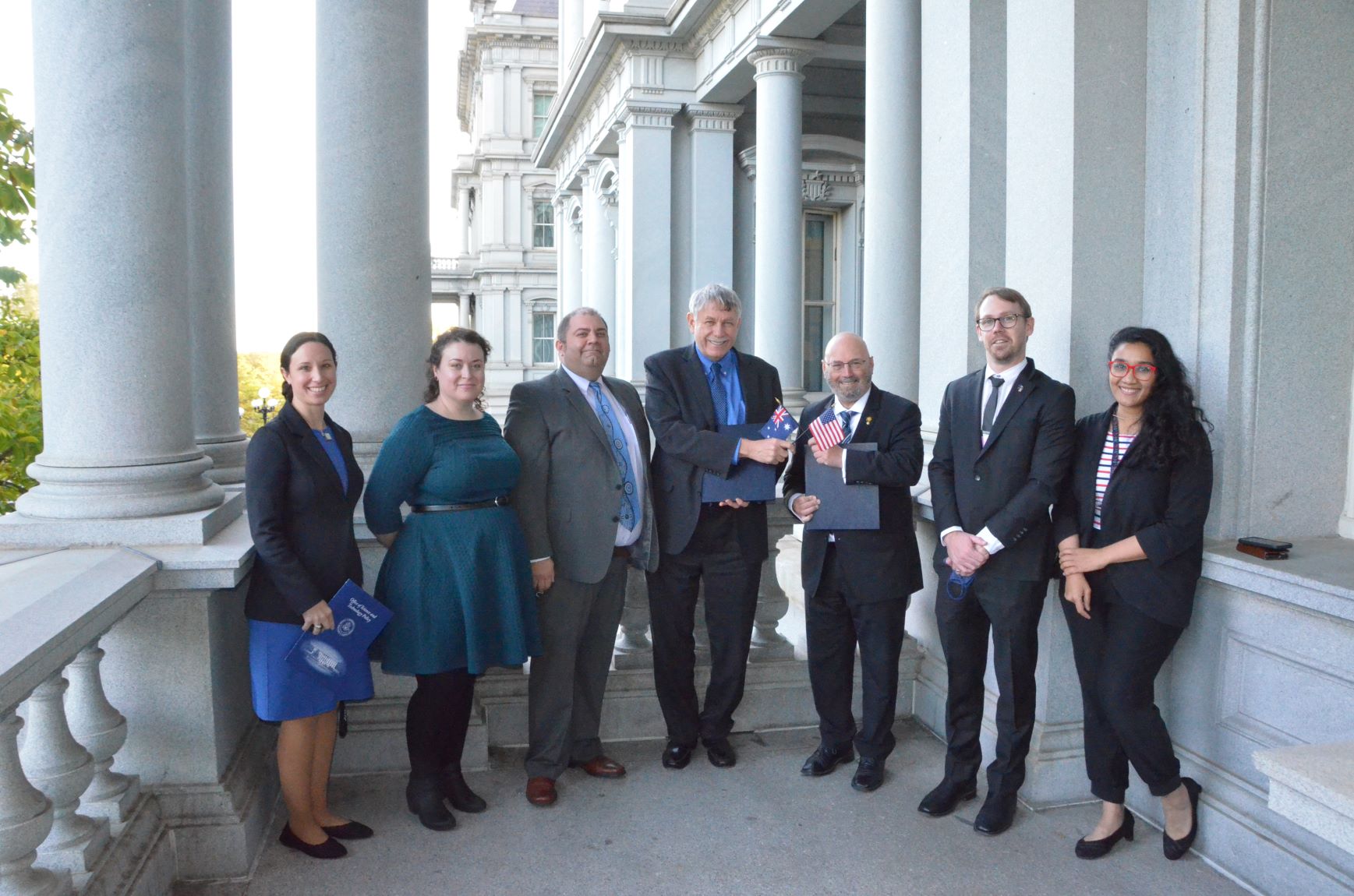
The United States and Australia Partner to Build Quantum Future
 Categories: International
 -
LPS Qubit Collaboratory holds Workshop on Gaps in Postsecondary Quantum Education and Training
(Nov. 10, 2021) On October 12, 2021, the Laboratory for Physical Sciences (LPS) Qubit Collaboratory (LQC) hosted a virtual Workshop on Gaps in Postsecondary Quantum Education and Training. The workshops brought together stakeholders from academia, industry, and government to discuss developing collaborations to fix the educational and training gaps in quantum information science (QIS).


Official websites use .gov
A .gov website belongs to an official government organization in the United States.

Secure .gov websites use HTTPS
A lock ( ) or https:// means you've safely connected to the .gov website. Share sensitive information only on official, secure websites.