-
DOE Announces $24 Million for Research on Quantum Networks
(August 31, 2023) On August 29, 2023, the U.S. Department of Energy (DOE) announced $24 million in funding for three collaborative projects in quantum network research.
Categories: DOE, Quantum Networking -
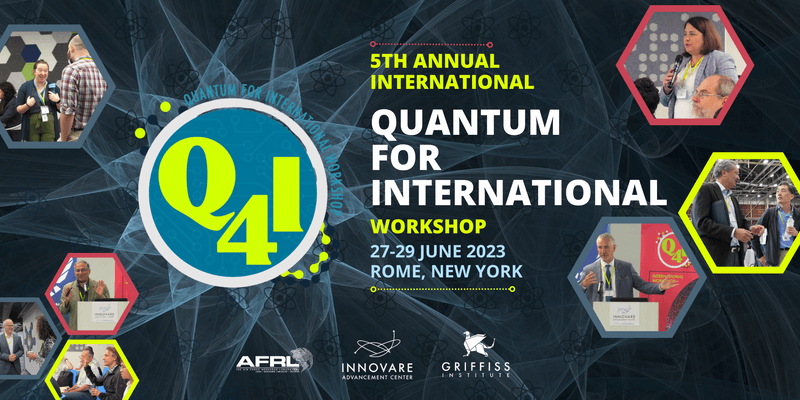
5th Annual Quantum for International (Q4I) Workshop
-
DARPA Proposers Day for Quantum Augmented Network Program
(May 2, 2023) The Defense Advanced Research Projects Agency (DARPA) Information Innovation Office (I2O) is sponsoring a Proposers Day to provide information to potential proposers on the objectives of the anticipated Quantum Augmented Network (QuANET) Broad Agency Announcement (BAA). DARPA’s QuANET program will develop a hybrid quantum-classical communication network architecture to enable quantum enhancements to security and covertness on today’s classical networks. The program seeks to augment existing software infrastructure and network protocols with quantum properties to mitigate some of the attack vectors that are pervasive on classical (non-quantum) networks.
Categories: Quantum Networking -
DOE Workshop on Quantum Computing and Networking
(April 26, 2023) The Department of Energy (DOE) Office of Science (SC) Advanced Scientific Computing Research (ASCR) program is sponsoring a Basic Research Needs (BRN) Workshop in Quantum Computing and Quantum Networking.
-
DOE Announces $4.6 Million to Provide Research Opportunities for Underrepresented Groups
(December 19, 2022) Last Wednesday, the Department of Energy announced $4.6 Million in awards for the Advanced Scientific Computing Research – Reaching a New Energy Sciences Workforce (ASCR-RENEW) program, whose goal is to increase participation of underrepresented groups in the quantum computing and networking workforce and to increase participation of underrepresented institutions in quantum computing and networking workforce training. This pilot program is intended to leverage ASCR’s unique national laboratory infrastructure and user facilities to provide training and research opportunities for students, postdoctoral researchers, and faculty from underrepresented groups and at institutions that are currently underrepresented in the ASCR portfolio such as non-R1 institutions of higher education and minority serving institutions (MSIs), including Historically Black Colleges and Universities.
-
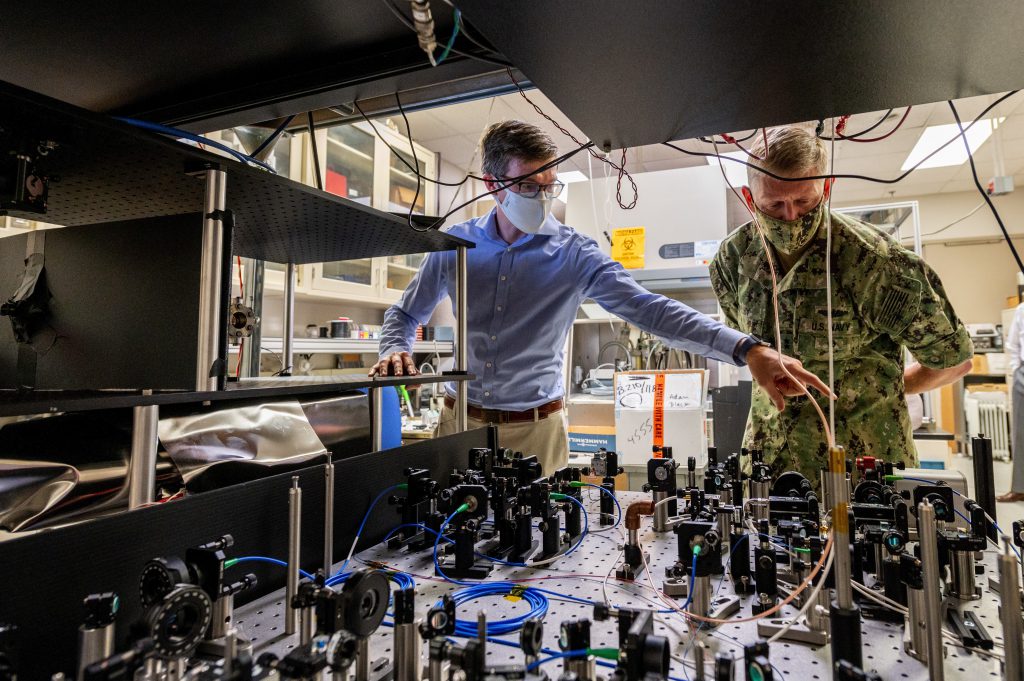
NRL Announces the Washington Metropolitan Quantum Network Research Consortium (DC-QNet)
 Categories: Centers, Quantum Networking
 -
DOE Announces $61 Million to Advance Breakthroughs in QIS
(August 19, 2021) The U.S. Department of Energy (DOE) announced $61 million in funding for infrastructure and research projects to advance quantum information science (QIS). Advances in QIS have the potential to enable new forms of computing, simulation, communication, and sensing that can advance breakthroughs needed to combat the climate crisis and strengthen America’s competitiveness.
Categories: DOE, Quantum Networking -
RFI on Access to Quantum Systems
(August 16. 2021) DOE releases Request For Information (RFI) : Access to Quantum System. In support of a congressional mandate in the Joint Explanatory Statement accompanying the Energy and Water Development and Related Agencies Appropriations Act of 2021, DOE has released the FRI to help in their effort to “develop a roadmap to provide researchers access to quantum systems so as to enhance the U.S. quantum research enterprise, stimulate the fledgling U.S. quantum computing industry, educate the future quantum computing workforce, and accelerate advancement of quantum computer capabilities.”
-
CRS Releases Defense Primer on Quantum Technology
(May 24, 2021) The Congressional Research Service has released a Defense Primer on Quantum Technology. See the report here.
-
NIST Researchers Take Counting Single Photons to an Unprecedented Rate
In high-end 21st century communications, information travels in the form of a stream of light pulses typically traveling through fiber optic cables. Each pulse can be as faint as a single photon, the smallest possible unit (quantum) of light. The speed at which such systems can operate depends critically on how fast and how accurately detectors on the receiving end can discriminate and process those photons.
Categories: Quantum Networking, Quantum Sensing


Official websites use .gov
A .gov website belongs to an official government organization in the United States.

Secure .gov websites use HTTPS
A lock ( ) or https:// means you've safely connected to the .gov website. Share sensitive information only on official, secure websites.