-
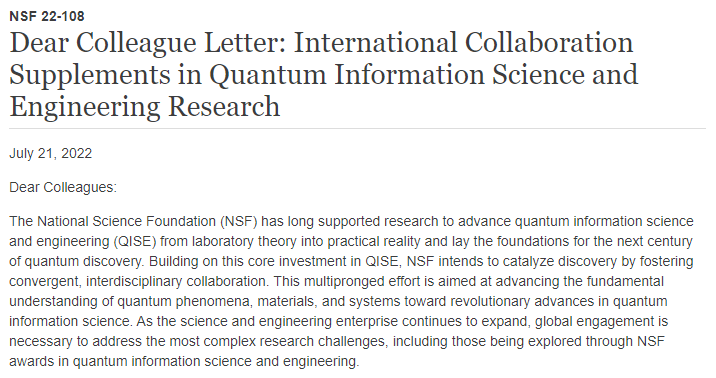
NSF Funding for International Collaboration in Quantum
-
IARPA Launching New Program on Entangled Logical Qubits
 Categories: Quantum Computing, R&D Funding Opportunities
 -
NSF Funds Access to Cloud-based Quantum Computing Platforms
(June 3, 2022) The National Science Foundation, in conjunction with Amazon Web Services (AWS), IBM, and Microsoft, is promoting the availability of cloud-based access to quantum-computing platforms to advance research and build capacity in the academic setting. With the Dear Colleague Letter NSF 22-092, NSF’s Directorate for Computer and Information Science and Engineering (CISE), the Directorate for Mathematical and Physical Sciences (MPS), the Directorate for Engineering (ENG), and the Directorate for Technology, Innovation and Partnerships (TIP) notified the research community of their intention to support supplemental funding requests for currently active NSF awards to enable use of these quantum-computing platforms. NSF’s supplemental funding will include support for graduate students as well as fees to work on these hardware and software quantum platforms.
-
Quantum Community Networking Workshops at National Laboratories
(May 26, 2022) The Department of Energy’s (DOE) Advanced Scientific Computing Research (ASCR) program is organizing two QIS community networking workshops. These are designed to increase participation of underrepresented groups in the quantum computing and networking workforce, and to increase participation of underrepresented institutions in quantum computing and networking workforce training.
-
NASA SCaN Quantum Faculty Fellowship Opportunities
NASA’s Space Communications and Navigation (SCaN) program office seeks to enhance faculty professional knowledge and leadership experience by offering two 10-week summer fellowship opportunities for educators who are interested in collaborating with world-class scientists and engineers in the areas of quantum communications and networks and quantum information science (QIS). The program is designed to enable faculty members to broaden their professional outlook towards quantum applications and STEM outreach of interest to NASA’s Quantum Science and Technology (QS&T) program.
Categories: R&D Funding Opportunities, Workforce -
AFOSR Funding Opportunities in STEM Education, Quantum Welcomed
(March 21, 2022) The Air Force Office of Scientific Research (AFOSR) has two funding opportunities involving STEM education, which could include quantum information science:
Categories: R&D Funding Opportunities, Workforce -
LPS Supports Young Investigator Program in QIS
(March 17, 2022) The Laboratory for Physical Sciences (LPS), which hosts a National Quantum Information Science Research Center called the LPS Qubit Collaboratory (LQC), is partnering with the Air Force Office of Scientific Research to support early-career scientists in the area of Quantum Information Sciences Research.
Categories: R&D Funding Opportunities, Workforce -
ExpandQISE Solicitation: Invitation to a Connections-Building Workshop
(Feb. 27, 2022) ExpandQISE Solicitation: Invitation to a connections-building workshop.
-
ARL and LPS release BAA on Quantum Computing in the Solid State
(January, 18 2022) A new Broad Agency Announcement (BAA) for the QC-S5 program, BAA # W911NF-22-S-0006 has been released. The U.S. Army Research Office (ARO), in collaboration with the Laboratory for Physical Sciences (LPS), is soliciting proposals for research in four research topic areas in the field of
gate-based Quantum Computing (QC) in the Solid State with Spin and Superconducting qubit Systems (QC-S5).
The topic areas are as follows:Categories: Quantum Computing, R&D Funding Opportunities -
DOE BER Releases FOA for Quantum-Enabled Imaging and Sensing for Bioenergy
The DOE SC program in Biological and Environmental Research (BER), through its Bioimaging Research effort, announced its interest in receiving applications to advance fundamental research or use-inspired technologies of new bioimaging or sensing approaches that exploit quantum phenomena. BER seeks to advance our understanding of bioimaging by using new quantum science-enabled areas that could resolve limitations of classical optics including resolution and detection limits, signal-to-noise ratio, limitations on temporal dynamics, long term signal stability, sample photodamage and limited penetration, or selective biomolecule sensing. Fundamental research concepts and use-inspired, early prototype research are needed to realize quantum-enabled bioimaging and sensing.


Official websites use .gov
A .gov website belongs to an official government organization in the United States.

Secure .gov websites use HTTPS
A lock ( ) or https:// means you've safely connected to the .gov website. Share sensitive information only on official, secure websites.