For quantum computing, different qubits are better together

darpa-program-harq-interior-2026

The Heterogeneous Architectures for Quantum (HARQ) program is now underway, working to address a fundamental challenge in quantum computing: how to scale beyond single-technology systems. Most current approaches rely on a single type of qubit, which forces system designs to inherit the limitations of that technology. HARQ is exploring a different model: integrating multiple qubit types within a single architecture, each selected for its strengths. Over the next 24 months, 19 teams across 15 organizations will develop the software and hardware needed to enable these systems, including cross-platform compilation tools and high-fidelity interconnects.

read more

NSF launches $100M National Quantum and Nanotechnology Research Infrastructure program

National-Quantum-Nano

The U.S. National Science Foundation is investing up to $100 million to establish a nationwide network of open-access research facilities for quantum and nanoscale technologies, innovation, and workforce training. Through the new NSF National Quantum and Nanotechnology Infrastructure (NSF NQNI) program, NSF will support up to 16 sites over five years, providing students, researchers, and industry with access to state-of-the-art fabrication and characterization tools, instrumentation, and expertise.

read more

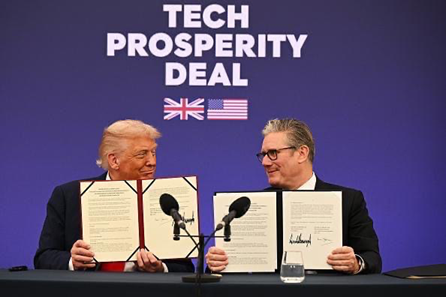
President Trump Signs Technology Prosperity Deal with United Kingdom that involves Quantum Computing

Securing-Quantum-Advantage

As the world’s leading quantum nations, the Participants are joining forces to seek to ensure the Participants are the first to realize true quantum advantage. Together, the Participants intend to build powerful quantum machines that transform defense, finance, and healthcare, protect the Participants’ citizens, and create high-skilled jobs. For example, quantum technologies could enable the simulation of complex molecules to accelerate drug discovery or optimize logistics and supply chains at a scale far beyond today’s capabilities. By combining the strength of the Participants’ national labs, the genius of their scientists, and the agility of their leading companies, the Participants intend to deliver unmatched innovation and keep their countries safe, prosperous, and leading the pack.

read more

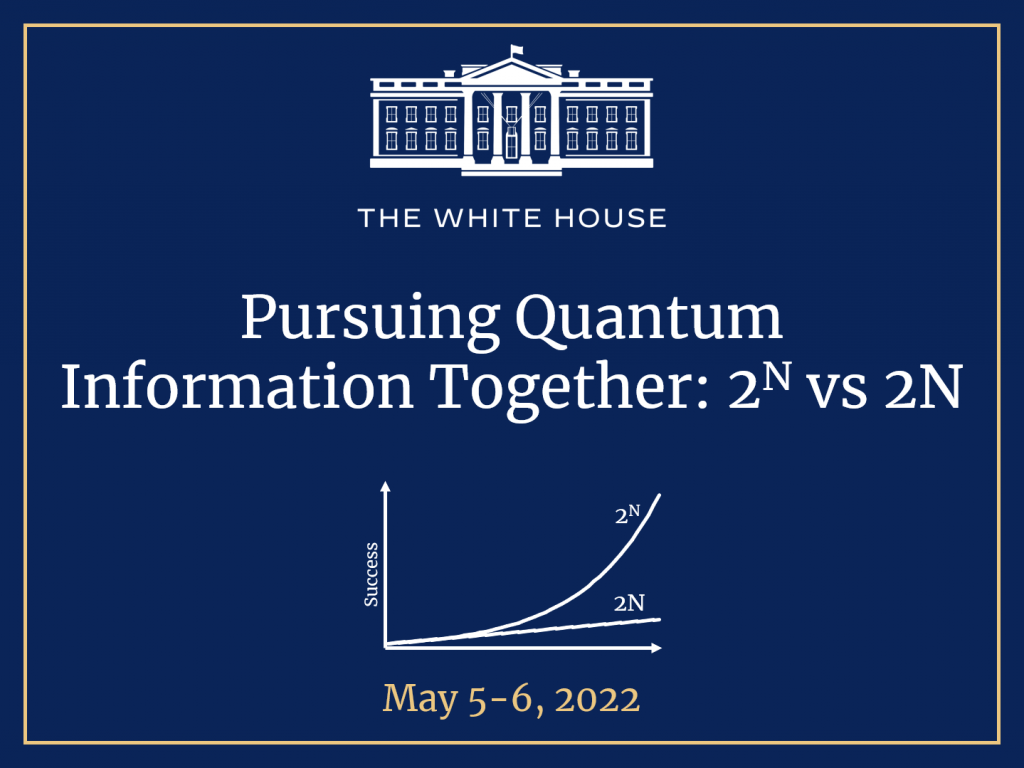
Readout: International Roundtable on Pursuing Quantum Information Together: 2^N vs 2N

pursing-quantum-information-together-poster

(May 07, 2022) The White House Office of Science and Technology Policy (OSTP) and U.S. Department of State hosted a dialogue this week to foster international cooperation in quantum science and technology. The roundtable, Pursuing Quantum Information Together: 2N vs 2N, was held on May 5th and 6th. Quantum Information Science and Technology (QIST)…

read more

A Quantum Wish

A-Quantum-Wish

Quantum mechanical objects, such as single atoms, can behave as if they are in two or more places at once, even though they are really in a single quantum “state.” Quantum mechanics also allows for quantum entanglement: two or more atoms can be correlated no matter their distance apart. If you believe the quantum math (which hasn’t failed us yet), with each new particle you add to the system, you double the information stored. A quantum computer made up of just 50 perfect quantum bits (or qubits) processes 250 = 1,125,899,906,842,624 complex numbers at the same time.

read more